The digital identity industry is asking the wrong question.
We spend a lot of time asking how to get more people to adopt digital wallets.
How do we convince them to download another app? How do we teach them to store credentials? How do we get them comfortable using a new identity system?
But what if none of that is necessary?
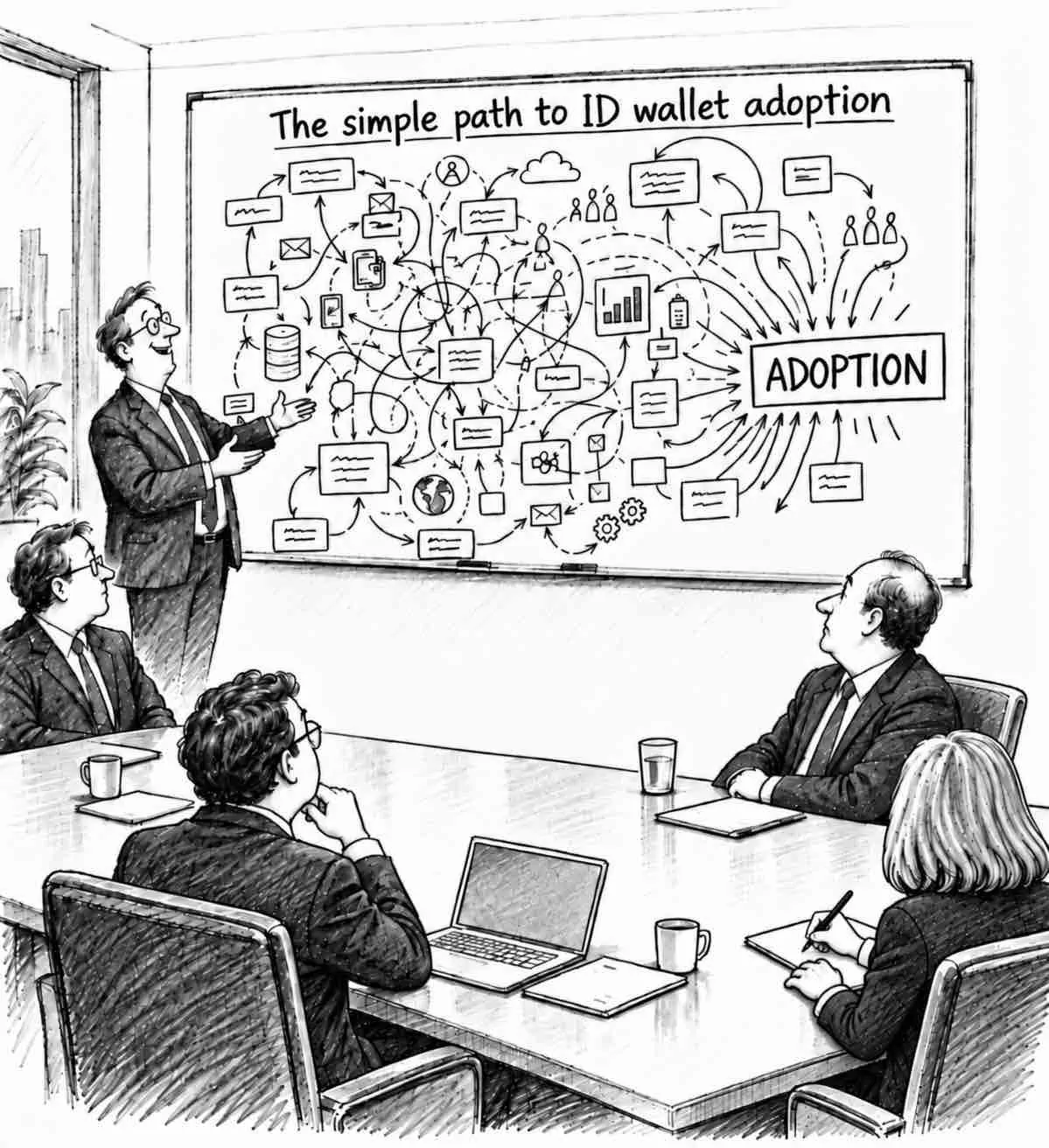
What if people could benefit from digital wallets without ever knowing they're using one?
Imagine this experience
You need to prove you're over 18 to access an online service.
Instead of downloading a separate identity wallet and figuring out how to use it, you receive a verification request in your banking app.
It's an app you already use and trust.
The request shows which website is asking for information and what it wants to verify.
You approve it using your phone's biometrics.
The website verifies a digital proof confirming you're over 18, without needing to see your date of birth.
That's it.
Behind the scenes, your bank could have created an age credential based on information it had already verified. Wallet functionality embedded in the banking app could handle the credential presentation, while the website checks the credential's authenticity and whether it comes from an issuer it trusts.
The bank and website would need to support this type of exchange, of course.
But from the user's perspective, it's simply another interaction with their banking app.
No new wallet app. No new technology to learn.
This is a hypothetical example, but it's the kind of experience we should be designing toward.
Wallets don't have to be destinations
We're used to thinking about digital wallets as standalone apps.
And there are good reasons for those to exist, particularly when people need to manage credentials from multiple issuers and present them across different services.
But that shouldn't be the only model.
There are other ways to deliver the same functionality:
- Standalone wallets: Dedicated applications where people can receive, manage and share their credentials.
- Embedded wallets: Wallet functionality built directly into existing applications, such as banking, telecom or insurance apps.
- Browser-based wallets: Experiences that let people access and share credentials through a browser, without downloading a dedicated mobile application.
And depending on the architecture, credentials can be stored locally on a device, in encrypted cloud storage, or through a combination of both.
These approaches aren't necessarily competing.
They can coexist, serving different users, contexts and security requirements.
The important point is that the user experience doesn't have to revolve around the wallet itself.
A user shouldn't need to understand verifiable credentials any more than they need to understand tokenization when tapping their phone to pay.
They just need the experience to work.
Of course, making wallet technology invisible doesn't mean making identity sharing invisible. People should still know what they're being asked to share, who they're sharing it with, and have control over that decision.
Maybe we're measuring the wrong thing
Consider two hypothetical digital identity projects.
Project A convinces 100,000 people to download a new wallet app, but only a small percentage regularly use it.
Project B integrates wallet functionality into an existing banking app. Nobody downloads a separate wallet, but customers regularly use the functionality to verify information with participating services.
Which project has been more successful?
If we measure success by wallet downloads, Project A looks better.
If we measure success by how many people actually benefit from reusable digital identity, Project B might be delivering significantly more value.
We think the second measurement matters much more.
Rather than focusing primarily on wallet downloads, perhaps we should be asking:
- How often do people successfully reuse credentials instead of repeating identity verification?
- How much friction can we eliminate from authentication and onboarding?
- How many services can accept credentials that customers already hold?
- Can we make these interactions simple while preserving privacy and user control?
Because the point of digital identity infrastructure isn't to make people use digital wallets.
It's to make identity verification easier, more secure and more reusable.
The future might be less visible than we expect
We don't think standalone digital wallets are going away.
But we do think we're underestimating the role of existing applications and browser-based experiences in making verifiable credentials useful at scale.
That's also why we're spending more time at Dock Labs working on embedded wallet SDKs, cloud wallets and browser-based wallet experiences.
We want organizations to be able to integrate verifiable credentials into experiences their customers already understand, rather than requiring those customers to adopt something entirely new.
Maybe the biggest breakthrough for digital wallets won't be the day everyone has one.
It'll be the day people use them every day without thinking about them.