
MCP INTEGRATION
Verifiable credentials, agent-ready
Two purpose-built MCP servers give AI agents scoped access to digital ID credential issuance, verification, DID management, and wallet operations, without handing them the keys to your identity infrastructure.
The control problem
Agents need identity operations. They shouldn't need full API access.
Giving an AI agent raw API keys creates unpredictable blast radius. MCP lets you define exactly what each agent can do with your identity infrastructure, and nothing more.
Least-privilege by design
Expose only the digital ID credential operations each agent needs. An agent that verifies credentials may not need to issue them, create schemas, or manage DIDs.
Conversational, not code-heavy
Agents interact with digital ID operations through natural language. No need to hard-code REST calls or teach an agent the full credential spec.
Your firewall, your control
Each MCP server is designed to run within your own environment, behind your firewall, configured with your API keys, with no centralized hosted dependency.
Two servers, clear responsibilities
Purpose-built for what agents actually need to do
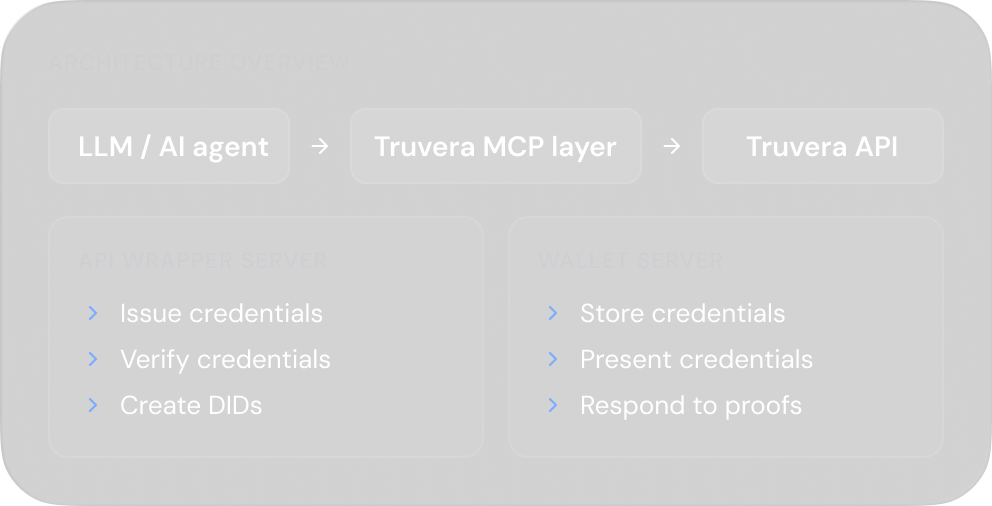
Truvera's MCP integration is split into two composable servers, each with a defined scope and a minimal attack surface.
Server 01 — API wrapper
Issue, verify, and manage verifiable credentials
Wraps Truvera's REST API and exposes credential lifecycle operations as MCP tools. The right server for agents that need to issue credentials, run verification checks, or create decentralized identifiers on behalf of an organization.
Issue credentials
Issue W3C-standard verifiable credentials from your existing schemas and attribute data.
Verify credentials
Generate and evaluate proof requests, check credential validity, and surface verification results.
Create DIDs
Create and configure Decentralized Identifiers, including profiles, names, and metadata, ready to anchor credentials or agent identity.
Server 02 — Wallet
Hold and present credentials
Gives agents access to a credential wallet, storing received credentials and presenting them in response to proof requests.
Store credentials
Receive and store verifiable credentials for use in agent workflows.
Present credentials
Present held credentials to verifiers, enabling agents to prove identity, authority, or eligibility in automated flows.
Respond to proof requests
Evaluate incoming proof requests and respond with the appropriate credential presentation, without human intervention.
Access control
Define what each agent is allowed to do
Scope to operations, not APIs
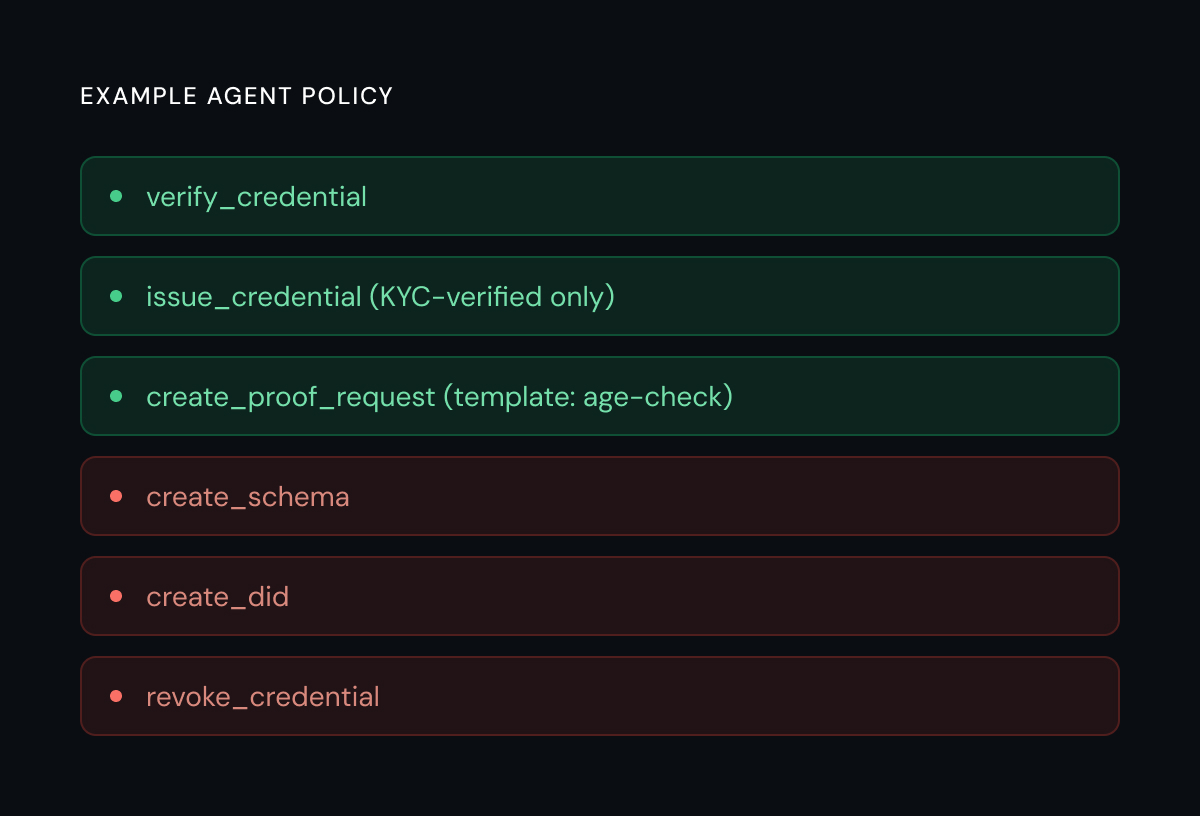
Allow an agent to verify credentials or issue specific credential types, while blocking access to schema creation, DID management, or admin operations.
Use predefined proof templates
Lock verification agents to specific proof templates so they can't request more data from holders than they're permitted to.
Shrink blast radius
If an agent is compromised or behaves unexpectedly, the scope of what it can affect is bounded by the MCP configuration, not limited only by your rate limits.
Use cases
What agents can do with Truvera MCP
From agent delegation to autonomous transaction approval, verifiable credentials are becoming foundational infrastructure for agentic commerce.
Delegated authority between agents
A person authorizes an agent to act on their behalf, or a primary agent delegates a task to a subagent. Before proceeding, the agent presents a credential proving its authority and scope. The receiving system verifies it programmatically, no human approval step needed at the point of interaction.
Autonomous transaction approval
A purchasing agent presents a verifiable proof of authorization before completing a transaction. The counterparty's agent verifies it instantly, establishing trust without manual review or shared secrets.
Cross-system identity verification
Two agents from different organizations need to collaborate. Each presents credentials establishing their identity, the organization they represent, and the scope of their permissions, automatically, at handoff time.
Credential-gated access flows
An onboarding agent issues an ID verification credential once a user is verified. Downstream agents across your platform accept that credential as proof, eliminating re-verification at every touchpoint.
Deployment
Runs in your environment, configured your way
The MCP servers are designed to run inside your own infrastructure. No hosted dependency, no third-party data path.
Docker container
Deploy either server as a container in your existing infrastructure. No new runtime dependencies.
Private repository
Currently in private access. Public repository and non-production licensing — similar to the Wallet SDK — coming soon.
API key configuration
Authenticate the MCP server to Truvera using your existing API keys. Simple to wire up inside any agent configuration.
Early Access
Ready to give your agents trusted identity?
The Truvera MCP integration is available to early access partners now. Get in touch to request access and discuss your use case.