Imagine your company deploys an AI agent to purchase equipment on its behalf.
You authorize it to spend up to $10,000 per transaction, with that permission valid for the next 30 days.
Within your systems, everything works perfectly. The agent has an identity, clearly defined permissions, and access to the tools it needs.
Then it finds a new supplier.
That supplier has never interacted with your agent. It doesn't use the same platform. And there's no existing integration between the two organizations.
The agent submits a purchase request for $8,000.
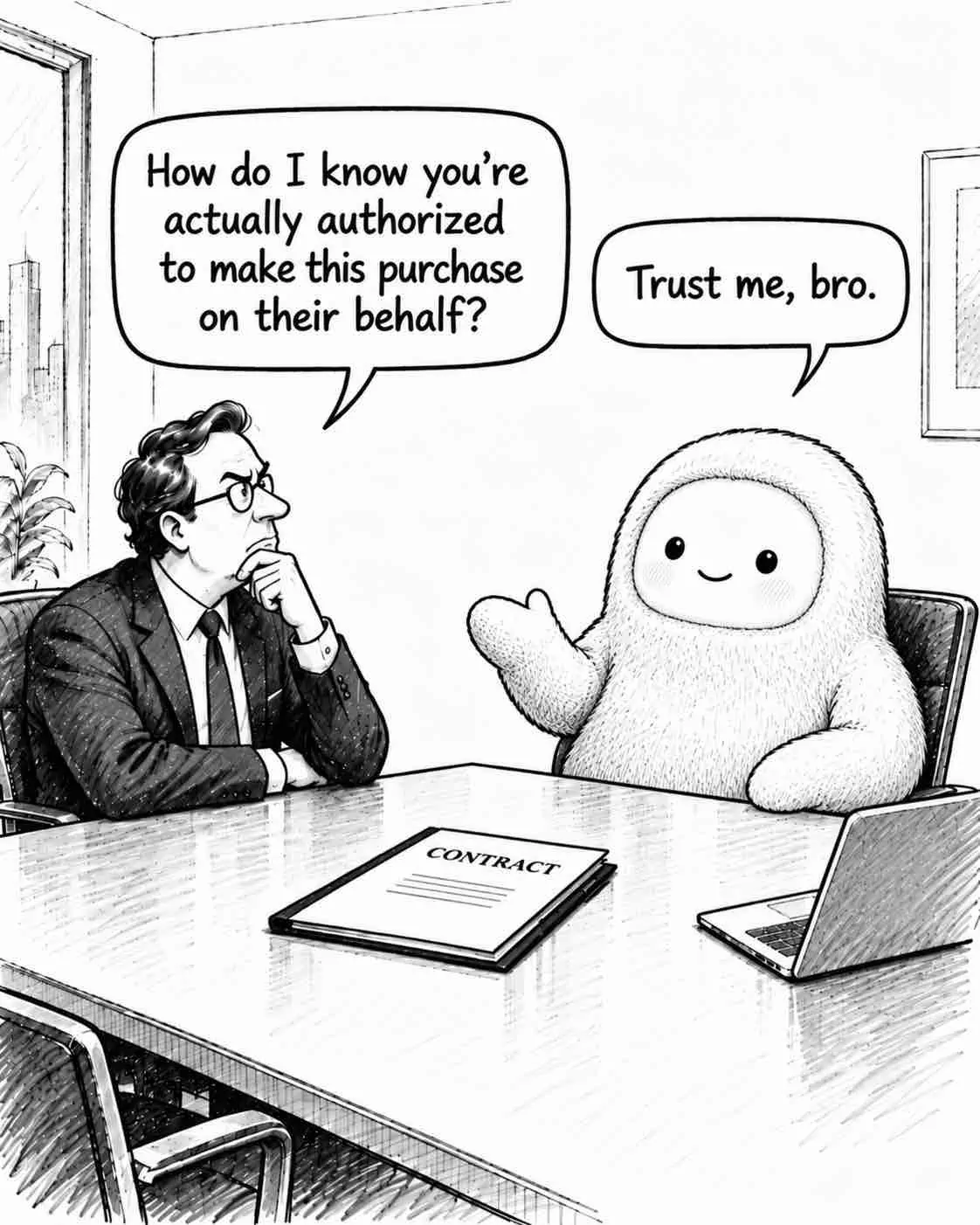
How does the supplier know the agent is actually authorized to make that purchase?
This is a problem we think we're seriously underestimating.
A lot of the conversation about AI agent security focuses on what happens inside a platform.
How do we authenticate agents? What tools can they access? What permissions should they have?
These are important questions, and we already have established technologies for addressing many of them.
But things get more complicated when agents start operating across organizational boundaries.
An access token issued for one service isn't automatically trusted by another.
And an agent claiming that its owner gave it permission doesn't make that claim trustworthy.
Think about what the supplier in our example actually needs to know.
Is this agent really acting on behalf of the company it claims to represent?
Did that company authorize it to make purchases?
Does that authorization cover this specific $8,000 transaction?
And is the permission still valid, or has it expired or been revoked?
The supplier needs a way to establish these things without simply taking the agent's word for it.
This is where verifiable authorization becomes interesting
What if, when your company authorized the agent, it also created cryptographically verifiable proof of that authorization?
That proof could identify the agent, the organization granting authority, its spending limit, and the period during which the authorization is valid.
When the agent approaches an external supplier, it could present that proof alongside its purchase request.
With the right infrastructure, the supplier could check that the proof was signed by the claimed issuer, that the requesting agent is entitled to use it, and that the authorization is still valid, including its revocation status where supported.
Verifiable credentials are one way to support this model. Other approaches, including OAuth-based delegated authorization, can also play important roles.
But there's an important distinction here.
Just because a proof is cryptographically valid doesn't mean the supplier should automatically trust it.
The supplier still needs to decide whether it recognizes and trusts the organization granting authority, whether that organization had the right to grant it, and whether the transaction satisfies its own policies.
Cryptography makes the evidence verifiable. It doesn't eliminate the need for trust decisions.
And we think that's an important part of the architecture we need to get right.
This is where agent identity and authorization need to evolve
We're designing increasingly sophisticated systems for controlling what agents can do inside our own environments.
But agents won't create their full potential value if they can only operate within those environments.
They'll need to work with suppliers, banks, merchants, platforms, and other agents that have no prior relationship with them.
We can't reasonably expect every external service to build a custom integration with every agent provider just to establish who an agent represents and what it's allowed to do.
We need interoperable ways for agents to present evidence of their authority across organizational boundaries, while allowing the receiving organizations to verify that evidence and make their own trust decisions.
That doesn't mean eliminating trust relationships altogether. It means making them more scalable, so each interaction doesn't require a new, bespoke integration.
The real challenge is making that permission independently verifiable by organizations that didn't grant it.
We think getting this right will be essential if we want agents to move beyond isolated platforms and operate across the wider economy.