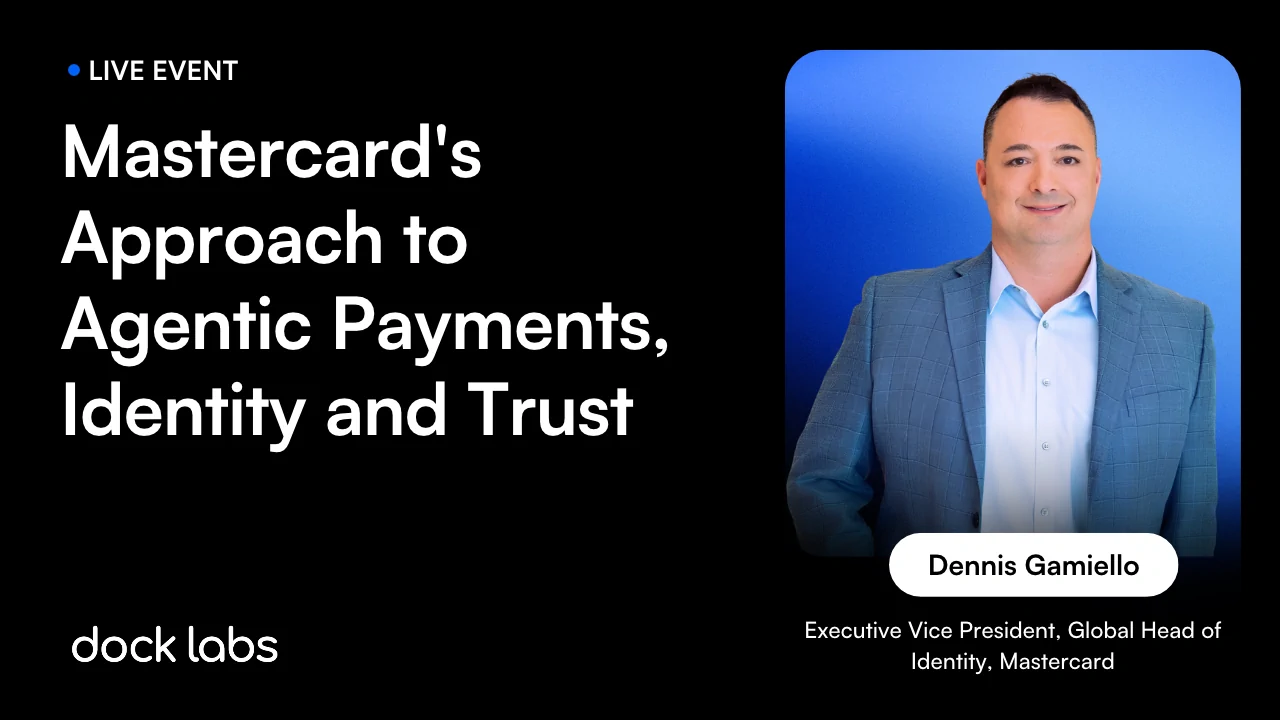
AI agents are moving past research and recommendations and starting to complete purchases. That creates a problem payment networks and merchants have not had to solve before: how to tell a legitimate agent acting with a customer's permission from a malicious one, and how to prove afterward what the customer actually asked for.
Dennis Gamiello, EVP and Global Head of Identity at Mastercard, has been at Mastercard for nearly 20 years, more than 12 of them focused on identity, fraud, and digital commerce. In this conversation he walks through Mastercard's Agent Pay trust framework and its five dimensions (identity, intent, controls, trusted execution, and intelligence), along with the thinking behind Know Your Agent, verifiable intent, and Agentic Trust and Intelligence Services.
The discussion also gets into the harder questions: who carries liability when an agent buys the wrong thing, which parts of the agentic stack need to be interoperable and which will stay proprietary, and how much autonomy consumers will actually hand over. The insights below capture where Mastercard is drawing those lines.
From blocking bots to recognizing agents
- Dennis argues that fraud detection has mostly been built to find bots on the assumption that bots are bad, and that fraud models now need to become "agent aware": recognize the agent first, then judge whether it is trustworthy in context.
- Trust has to run in both directions: the AI platform where a transaction starts must be trusted, and the merchant where the agent lands must also be trusted so that the agent itself is not tricked.
- Dennis' view is that the technology alone will not make agentic commerce scale; confidence across consumers, businesses, and every other party in the ecosystem is the real constraint, even as standards start to move faster.
Mastercard's five-part trust framework
- Agent Pay is Mastercard's set of capabilities and trust framework for agentic commerce, and Know Your Agent (KYA) is established within it.
- The framework has five dimensions: identity (who is behind the agent, which is where consent is established), intent (what the agent is authorized to do), controls (limits the consumer sets, such as spend or time of day), trusted execution (secure money movement and credential protection), and intelligence (context and risk signals that inform decisions).
- Trusted execution builds on payment tokenization that has already scaled across card-on-file and digital wallets, so Agent Pay extends existing infrastructure rather than introducing new rails.
- Mastercard's Agentic Trust and Intelligence Services, announced in September, combines contextual data, behavior, identity data, and fraud intelligence to help merchants, issuers, and partners assess agents at each stage of the journey.
Verifiable intent as the new evidence layer
- Dennis separates authorization from intent: an approved payment is the authorization, while intent captures what the agent was permitted to do, such as price, size, or color.
- Verifiable intent is tamper resistant and shared only with the parties that need it, for example as evidence in a dispute or to populate a digital receipt that clears up consumer confusion.
- Dennis expects Mastercard's compelling evidence standards to evolve to recognize verifiable intent data, making it the basis for determining liability in agent-initiated disputes.
- The evidence works in both directions: consumers keep fraud protection, and businesses gain a defense against friendly or first-party fraud because the data can show the consumer did authorize the purchase and its attributes.
- Mastercard developed the verifiable intent standard in collaboration with Google and is advancing it with the FIDO Alliance, using verifiable credentials underneath.
Where interoperability matters and where it does not
- Dennis draws the line clearly: evidence such as verifiable intent and digital identity credentials needs to be interoperable across ecosystems, while intelligence is likely to stay proprietary because each party has its own data and vantage point.
- He does not expect one platform to issue and manage agent identities and permissions; the consumer comes first, and consumers will choose among platforms much as they choose today between storing a card with a merchant or using a wallet.
- Dennis expects a mix of single general-purpose agents and multiple task-specific agents, and says some fragmentation will always remain, which is why trust frameworks and standards carry so much weight.
- Partnerships extend the view of a transaction: Mastercard's work with Cloudflare combines web data and signals with payment intelligence to determine earlier whether traffic is an agent and whether it is trusted.
Adoption, autonomy, and friction
- Mastercard projects that by 2030 one in ten shoppers will use agentic commerce for everyday purchases, covering either the shopping or the paying step, which Dennis put at over 300 million people worldwide before counting business-to-business transactions.
- Agent Pay has been live since April 2025, with US cardholders enrolled and transactions completed in the US, Europe, Asia-Pacific, Latin America, and the Caribbean.
- Dennis frames consumer autonomy as earned: people start with everyday purchases, and each successful, uncompromised transaction makes them willing to try something more complex, at a pace that will vary by consumer and demographic.
- Agent Pay for Machines, announced in June, targets programmable autonomous purchasing for businesses; Dennis's example was a new flower shop owner whose agent buys the domain, hosting, content, and inventory tools after a single instruction.
- On reducing friction, Dennis expects occasional reauthentication, similar to confirming a new device, with passkeys making that step lighter; for autonomous and machine-to-machine transactions, intelligence carries more of the load.
- Nick raised a concern about assistants that act by logging in as the user, making the agent indistinguishable from the person and the event hard to reconstruct when something goes wrong; in Mastercard's model, AI platforms are registered agents and the link to the consumer is established at consent, for example through biometric authentication.