Some large companies have started blocking AI agents from their platforms. The problem they are reacting to is real: a merchant has no good way to tell who stands behind an agent, what it was authorized to do, or who’s liable when something goes wrong.
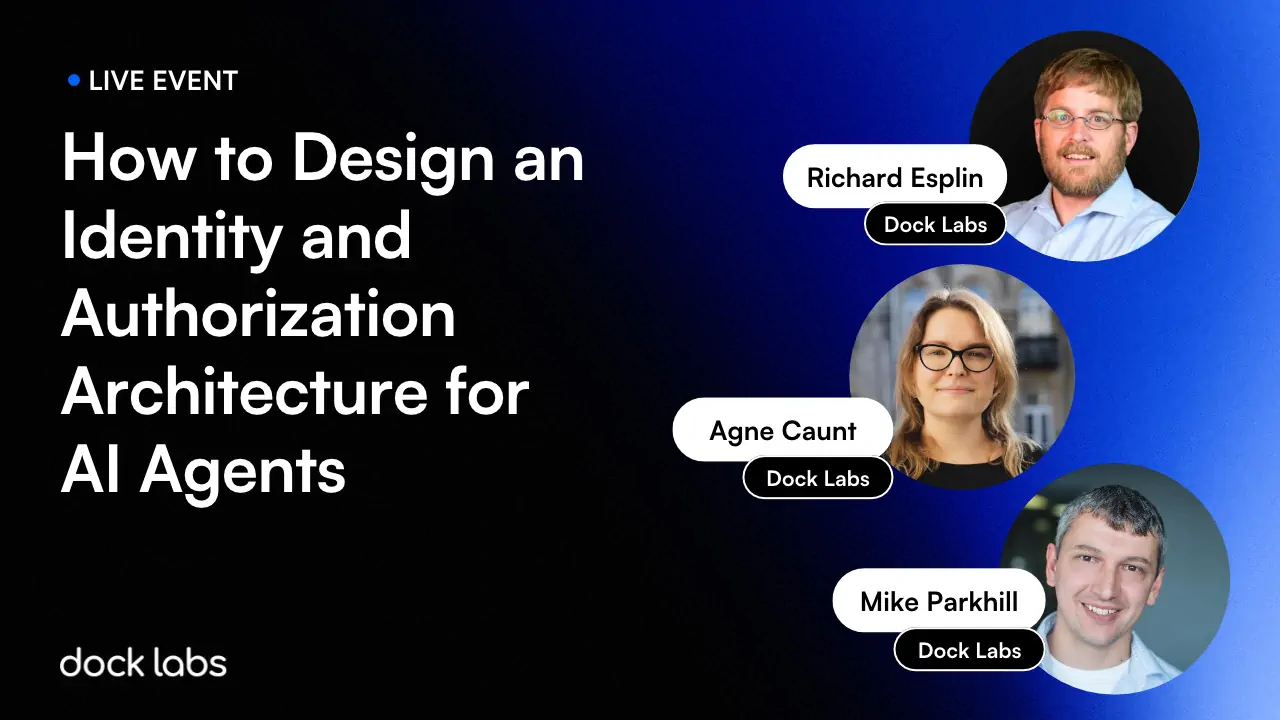
This session takes a system architect's view of that problem. Agne Caunt, Product Owner at Dock Labs, walks through six decisions an organization has to make before it deploys an agent that acts on its behalf, using a concrete scenario: an office manager, her company's gift-buying agent, and a merchant that has never dealt with either of them. Mike Parkhill, Head of Engineering at Dock Labs, weighs in on what "know your agent" should actually cover and why he expects a few large players to settle the current race between agent identity protocols.
The insights below cover how to write agent policy that can be enforced, when OAuth is the right tool and when verifiable credentials are, where an agent's delegated authority should be stored, the six checks a merchant needs to run, and why revocation and audit are where accountability is ultimately proven.
Agent access is a trust problem before it is a technology problem
- Services are already turning agents away. Richard Esplin cited United Airlines and Amazon saying no to agents on their platforms, and retailers describing agents that call customer support repeatedly and create chargeback liability, in a space with little regulation on what is required before an agent's claims can be trusted.
- Richard framed the central architecture question as a business one: what evidence does the relying party need so that chargebacks are prevented and someone takes responsibility for the agent's actions? In his view, choices about credentials, storage and protocols all follow from that answer.
Policy comes first, and it has to be machine-checkable
- Agne Caunt described the first decision as a business and policy decision, not a technical one: write down which actions an agent may never take without supervision, which require a human in the loop, and which it can complete on its own. The third category is where the architecture work is.
- Permissions are scoped by role (a CFO, an office manager, and the agent at the bottom of the hierarchy), and each capability is narrowed by constraints. In the example, the agent Atlas can see the partner list but only names and addresses, can buy only pre-approved goods under a per-gift price limit ($100 on the slide), and can ship only with approved carriers for delivery within a set timeframe (10 business days on the slide).
- Agne's rule: write policy so it can be checked later, using budgets, recipients, deadlines and action types. "Go buy good gifts for our partners" might be enough direction for an intern, but not for an agent, because the policy has to be enforceable technically and verifiable afterward.
Identifying the agent depends on who has to check it
- Agne set aside the debate over whether agents need identities or identifiers; what matters is reliably tying a set of permissions and tasks to a specific agent. She outlined three options: SPIFFE/SPIRE for agents running on your own infrastructure, OAuth for services that already know the user (including the act claim and client ID metadata documents), and verifiable credentials issued by the organization and checkable by anyone who trusts the same registry.
- The hard part of the credential option is coordination, not technology. Richard said agent identity credentials can be done today if everyone uses the same trust service; Agne noted that open trust registries for enterprises and shops do not exist yet, though some are starting in the EU.
"Know your agent" means different things to different people
- Richard observed that KYA is used to mean the agent's identity, its developer, or the human behind it, and each may call for a different technology. Mike Parkhill compared it to KYC: the depth of checking depends on risk tolerance, and possible attributes include developer, publisher (which may differ when a subcontractor builds the agent), lifecycle, instance ID and software version.
- Mike described a protocol war in agent identity. He expects a few large players to eventually settle the approach, as has happened with other technologies, but noted that some key players are currently hedging by backing several options.
OAuth versus credentials is a fit question, not a winner question
- Agne proposed five questions for choosing how delegated authority travels: Does the agent act on an existing account? Do both sides use the same enterprise IdP? Does authority come from a party the service has never dealt with? Will the agent deal with many or frequently changing services? Does the proof need to reach someone later, such as an auditor? Yes to the first two points toward OAuth; yes to the last three points toward credentials.
- Agne and Mike both acknowledged OAuth's installed base. Mike noted that every IAM manager already knows OAuth and expects its existing deployment base to give agentic OAuth extensions a step up, while predicting limits where other approaches will be needed. Richard relayed that a member of an OpenID Foundation technical group told him they started with OAuth to keep enterprise rails useful, but know VCs need to be standardized for agentic flows.
Where the authority lives decides who controls the agent
- With OAuth, the authorization server holds the grant and the agent holds a token pointing to it, so the agent's authority is only as safe as wherever that token is stored. Agne noted that newer designs keep the user's login in a platform vault and give the agent a short-lived token for a single task.
- With credentials, Lisa's own credential stays in her wallet. Atlas gets a narrower delegated credential in its own wallet and presents it without calling back to the issuer, which makes control of the wallet key the critical point.
- Agne compared three wallet locations: inside the agent (simplest, but only as safe as the agent), run by the agent platform, or run by the organization (most control over key rotation and revocation). Because the wallet and audit trail need to outlive short-lived agents, she saw the in-agent wallet as less suitable, at least for commerce.
The organization deploying the agent needs the merchant to verify
- Agne argued that the agent's owner has a direct stake in verifier-side checks: if the merchant skips them and the agent orders outside policy, the owner either pays or ends up in a dispute over who is responsible. Checks therefore need to be easy enough that merchants actually run them, a challenge she compared to relying-party adoption in EUDI, and they may come preconfigured through payment or checkout providers.
- She listed six checks: the issuing organization belongs to a trusted ecosystem; the credential was issued by that organization; it was issued to this agent and this agent is presenting it; the delegation chain is intact; the order is within policy; and the credential has not been revoked. The merchant still makes the final call and may add its own rules, such as an agent reputation threshold.
Identity and payment credentials play separate roles in the same flow
- Asked whether the agent carries an identity or a payment credential, Agne said both, likely as separate credentials. Mike added that emerging agentic commerce standards define flows rather than credential formats, with different credentials signed by different parties at each step; he expects identity credentials to be reusable and payment credentials to be closer to one-time tokens from the payment rail.
- Agne highlighted AP2's mandate types: an intent mandate (open cart), where the agent buys within conditions approved in advance, and a cart mandate (closed cart), where the human approves one specific cart that cannot be reused. She noted that AP2 and Mastercard's Verifiable Intent are both VC-based and being merged, and sees this as another argument for credentials if agentic commerce is on the roadmap.
Revocation and audit are where accountability is proven
- If Lisa leaves, revoking her credential also revokes the agent's credential; a successor can issue a new delegation, and the audit trail shows which person authorized which orders over time. Agne stressed that every agent action must be tied to a person, and because agents act at machine speed and volume, audit records have to be generated automatically rather than reconstructed later.
- Agne compared a merchant-signed verification receipt (which depends on the agent passing it back; the slide labels this the approach used today) with wallet-side reporting (labeled on the slide as being considered), which does not rely on the agent but centralizes reporting with the wallet provider. She expects a combination of both. She flagged an unresolved tension: agents do not need privacy, but reporting on an agent is reporting on the human who authorized it.