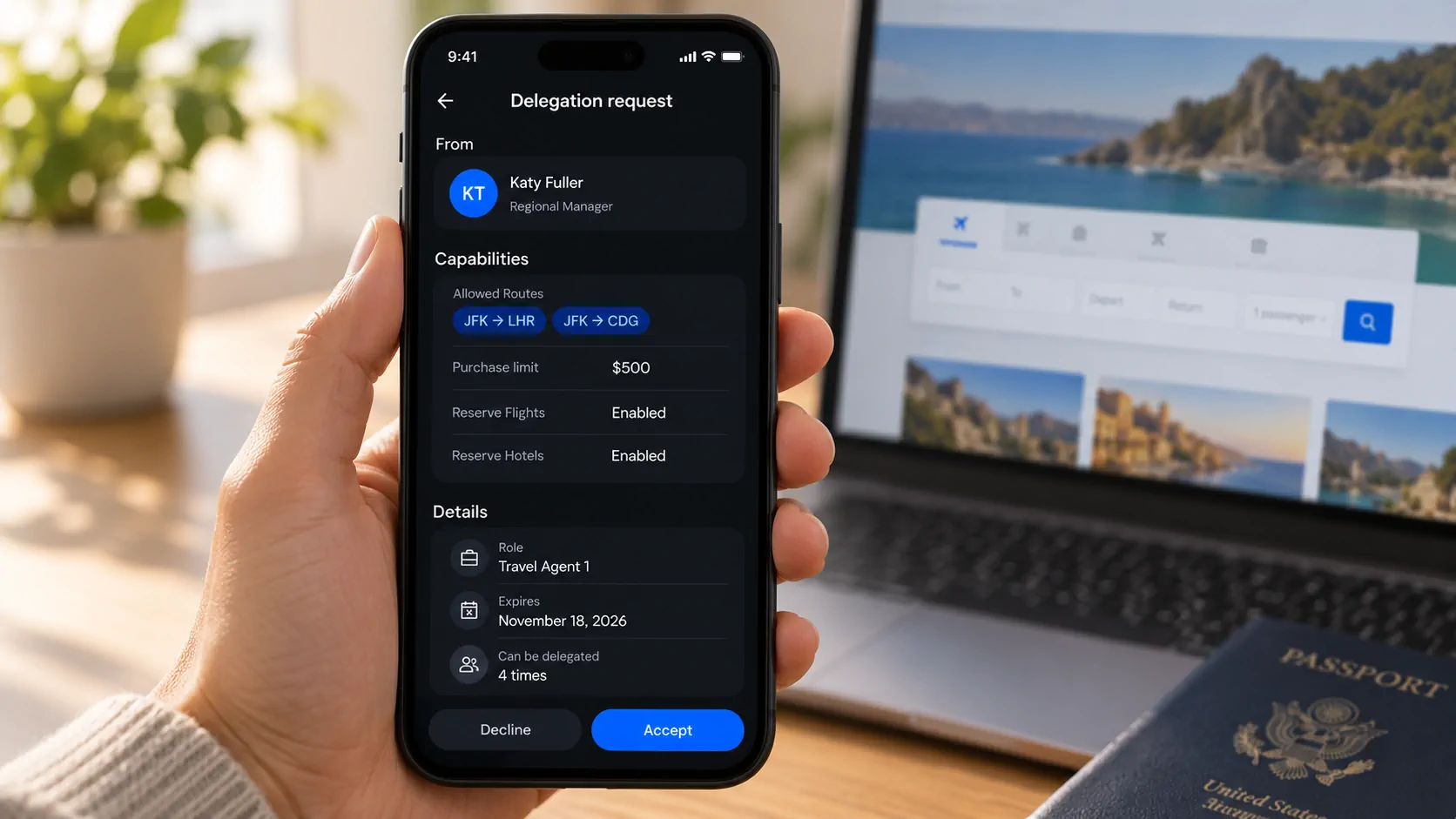
Dock Labs today announced Authority Delegation for AI agents in their Truvera platform, enabling businesses to verify who authorized an AI agent, what it is allowed to do, and the limits of that authority before allowing it to act.
As AI agents increasingly act on behalf of people and organizations, businesses need to know more than which agent they are dealing with. They need to know who authorized it, what it has permission to do, and whether that authority is still valid.
Today, there is no widely adopted way for an AI agent to carry verifiable authority across organizations. Businesses are left relying on proprietary integrations, manual checks, or assumptions about what the agent is allowed to do.
With Truvera, a person or organization can define the exact authority given to an AI agent, including permitted actions, spending limits, timeframes, counterparties, and other constraints.
The agent receives this authority as a verifiable credential. When it interacts with another organization, that organization can verify the credential before accepting the agent’s action.
This allows authority and accountability to be established before an agent acts, rather than reconstructed afterwards.
“AI agents are going to interact with businesses that have never seen them before. The question is not simply ‘who is this agent?’ It is ‘why should I trust it to do this?’” said Nick Lambert, CEO of Dock Labs. “We believe authority needs to become portable. An agent should be able to carry verifiable proof of what it has been authorized to do, just as people and organizations will increasingly carry reusable proof of who they are and what they are entitled to do. That is the trust infrastructure the agentic internet will need.”
Making trust reusable for AI agents
Organizations already establish trust every day by verifying customers, employees, suppliers, permissions, and entitlements.
Truvera makes that trust portable through verifiable credentials that can be recognized outside the system where it originated. Authority Delegation extends the same model to AI agents.
Instead of requiring every business to establish its own trust relationship with an agent, the agent can present verifiable proof of authority issued by a trusted party.
Trust can travel with the agent.
For example, an office manager could authorize an AI agent to purchase office supplies from approved suppliers, spend no more than $500, and operate for seven days. A supplier could verify those permissions before accepting an order.
If the agent attempted to exceed its authority, such as by spending more than the permitted amount or acting after the authorization expired, the credential would no longer authorize the action.
Truvera Authority Delegation also supports Agent Payment Protocol (AP2) mandates for agentic commerce and can be integrated into agent workflows through Truvera’s MCP servers, currently available in early access.
AI agents will increasingly interact with organizations where no pre-existing trust relationship exists. Truvera is building the infrastructure that allows identity, authority, and other trusted facts to move between those systems in a form machines can verify.
Truvera Authority Delegation for AI agents is available today.
For a deeper look at how this works under the hood, read our technical deep dive into how we designed verifiable chains of authority for AI agents.
To schedule a demo, click here.