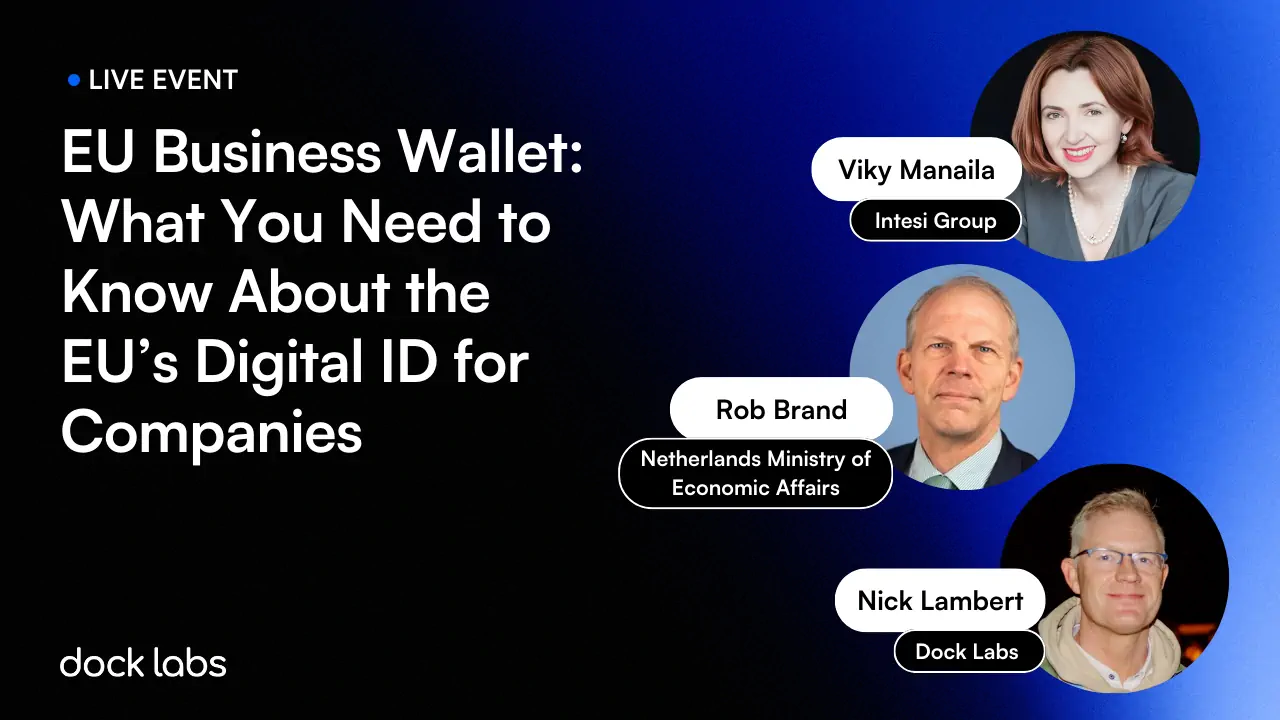
As the European Commission moves forward with its proposal for the EU Business Wallet, many organizations are asking what this new regulation actually means in practice and how it will change the way businesses identify themselves, exchange data, and interact with public authorities across Europe.
To unpack this, we recently hosted a deep-dive session with two people directly involved in shaping and implementing the initiative: Viky Manaila, Trust Services Director at Intesi Group, and Rob Brand, Senior Policy Officer at the Netherlands Ministry of Economic Affairs and Co-Coordinator of the WE BUILD Consortium.
The session explored what the EU Business Wallet is designed to do, why it matters for businesses of all sizes, and how it builds on eIDAS 2 and the European Digital Identity framework. We covered the regulatory proposal itself, the role of trust service providers, mandatory public-sector acceptance, and the real-world use cases being tested today through large-scale pilots.
Below are the key takeaways from that conversation, capturing what stood out most for businesses, wallet providers, and ecosystem builders preparing for what comes next.
What the EU Business Wallet Is and Why It Matters
- The EU Business Wallet is a new regulatory framework enabling businesses to identify themselves, exchange verified data, and communicate securely across all EU member states.
- Unlike citizen wallets, public sector bodies must accept EU Business Wallets, but private companies are not obligated to adopt them. Adoption is expected to be market-driven due to clear efficiency gains.
- The regulation introduces two foundational building blocks:
- A European Digital Directory for discoverability and trusted contact.
- A secure, legally binding communication channel for documents and data.
A Shift from Documents to Verifiable Business Data
- The wallet replaces PDFs, scanned documents, and notarized copies with electronic attestations of attributes (EAAs) issued by authoritative sources.
- These attestations can be:
- Shared directly between wallets
- Used to sign, seal, and submit documents
- Verified cryptographically instead of manually reviewed
- This shift directly addresses growing risks from AI-generated document fraud and manipulated invoices.
Secure Communication as a First-Class Capability
- A core feature of the Business Wallet is a Qualified Electronic Registered Delivery Service (QERDS).
- This provides:
- Proof of sender and recipient
- Proof of delivery and integrity
- Legal equivalence across all EU member states
- It standardizes secure B2B and B2G communications across the EU for the first time.
Mandatory Acceptance by the Public Sector
- Public sector bodies must accept EU Business Wallets for:
- Identification and authentication
- Signing and sealing documents
- Submitting official documents
- Sending and receiving notifications
- Timelines:
- 24 months after entry into force for general acceptance
- 36 months transitional period for communication channel support
Who Can Provide EU Business Wallets
- Wallet providers must:
- Be established and operating in the EU
- Not be controlled by third countries or entities
- Providers can include:
- EU-based private companies
- EU institutions, bodies, and agencies
- Existing Qualified Trust Service Providers (QTSPs) benefit from a lighter onboarding process due to existing compliance.
Supervision and Trust Are Built In
- Supervision is handled by existing eIDAS supervisory bodies, avoiding the creation of new authorities.
- Oversight is primarily ex-post, enabling faster market entry while preserving accountability.
- Providers must notify regulators of:
- Structural changes
- Security incidents
- Suspensions or revocations
Interoperability Is the Core Design Principle
- Business Wallets must interoperate with:
- Other EU Business Wallets
- EUDI (citizen) wallets
- Relying parties and public authorities
- Common protocols and interfaces will be finalized via implementing acts, reducing fragmentation across member states.
The WE BUILD Consortium as a Real-World Testbed
- WE BUILD is a Large-Scale Pilot aligned with the Business Wallet regulation.
- It is coordinated by organizations including national business registers, signaling strong institutional backing.
- The pilot spans three domains:
- Business
- Supply chain
- Payments
High-Impact Business Use Cases Identified
- Priority use cases emerging from WE BUILD include:
- KYB / KYC for businesses
- Creating company branches across borders
- Foreign tax declarations
- Delegated authority and representation
- Access to Once-Only Technical Systems (OOTS)
- These use cases directly target cross-border friction, one of the EU’s longest-standing digital challenges.
- The Business Wallet is particularly impactful for:
- Trade and logistics
- Transportation
- Compliance-heavy supply chains
- It enables trusted data sharing across multi-party chains where compliance evidence must be repeatedly proven.
Tendering and Public Procurement as a Major Opportunity
- Public procurement was highlighted as a strong future use case.
- In countries like the Netherlands alone, tens of billions of euros flow through public tenders annually.
- Business Wallets could:
- Simplify eligibility verification
- Enable cross-border participation
- Reduce fraud and administrative overhead
Delegation and Representation Are Central Capabilities
- The wallet supports delegated authority, allowing individuals to act on behalf of a company.
- This includes:
- Proving representation rights
- Signing with personal credentials while binding actions to the company
- It creates a clear link between personal identity wallets and business wallets.
Adoption Depends on “Non-Empty Wallets”
- A key risk identified is the creation of empty wallets with no usable attestations.
- Success depends on:
- Authentic sources issuing credentials at scale
- QTSPs and registries participating early
- In WE BUILD alone, over 50 different attestations were identified across 13 use cases.
Cultural and Organizational Change Is Required
- Beyond technology, adoption requires:
- Education for businesses and public officials
- Acceptance that verifiable credentials replace document copies
- Trust in legal equivalence without manual verification
- This represents a paradigm shift, not just a tooling upgrade.
The Regulation Is Intentionally Global
- Non-EU companies can:
- Own and use EU Business Wallets
- Be listed in the European Digital Directory
- Interoperability with equivalent non-EU wallets is explicitly anticipated, as long as security and assurance levels match.
Five-Year Vision: Normalized, Invisible Infrastructure
- In five years, the speakers envision:
- Businesses spending less time on administration and compliance
- Seamless use of personal and business wallets together
- Cross-border business operations feeling “local” again
- The ultimate goal is EU competitiveness, not technology adoption for its own sake.